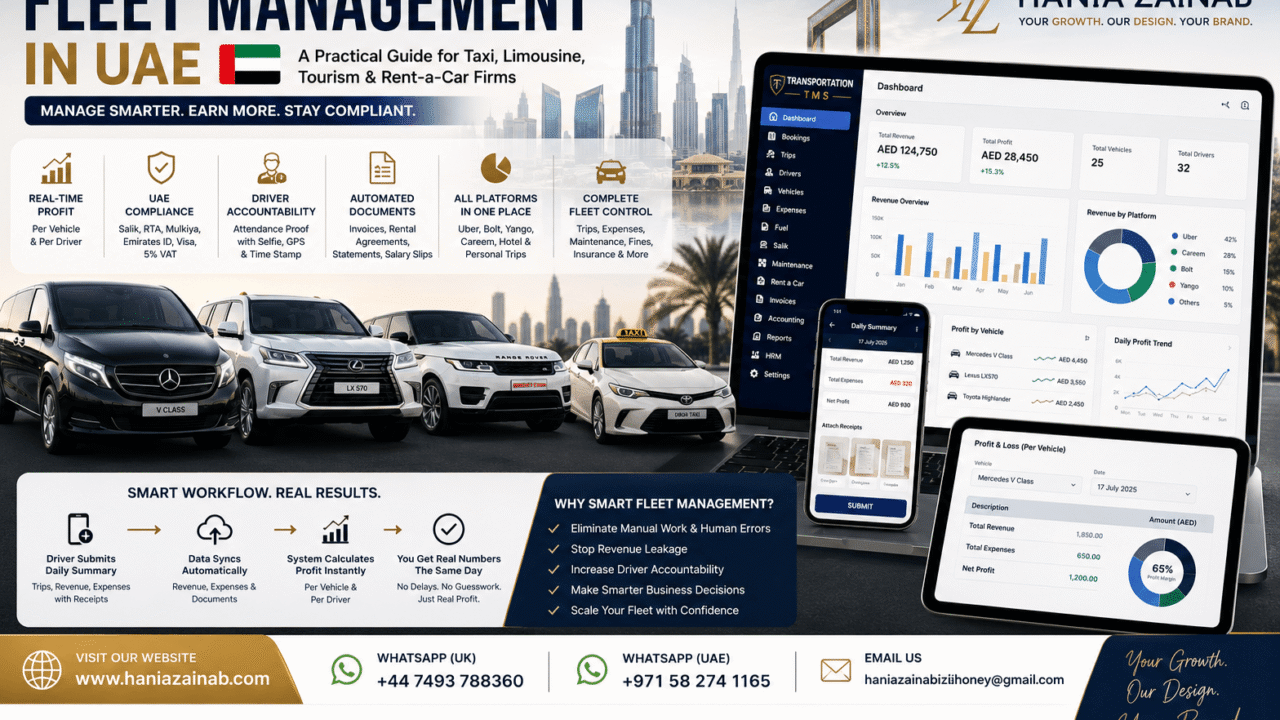
Fleet Management in UAE: A Practical Guide for Taxi, Limousine & Rent-a-Car Firms
Fleet management in the UAE is not the same job it is anywhere else. Between Salik toll deductions, RTA card and Mulkiya expiries, Emirates ID and visa dates, 5% VAT and daily payouts from Uber, Bolt, Yango and Careem, a transport company here has to track things a foreign fleet owner never thinks about. Get it right and you know exactly which driver and which vehicle made you money this week. Get it wrong and the month ends with a spreadsheet, a WhatsApp group and a guess.
This guide breaks down what fleet management actually involves for a UAE limousine, taxi or rent-a-car business, where money quietly leaks, and how to decide when it’s time to move from manual tracking to proper software.
What fleet management in the UAE really covers
For a local operator, fleet management is far more than “knowing where the cars are.” A complete picture includes:
- Revenue per trip and per platform — Uber, Bolt, Yango, Careem, hotel bookings and personal trips, plus tips and advances.
- Vehicle costs — fuel, Salik, parking, maintenance, fines and insurance, matched to the right car and date.
- Driver accountability — attendance you can actually prove, duty hours, and per-driver profit.
- Compliance — RTA permits, Mulkiya renewals, visa and Emirates ID expiries, and 5% VAT on every invoice.
- Documents — branded invoices, rental agreements, statements and salary slips that look professional every time.
Miss any one of these and you don’t have a fleet you’re managing — you have a fleet that’s managing you.
Where UAE transport companies quietly lose money
Most owners don’t lose money on big dramatic mistakes. They lose it in small, repeated leaks that a manual system can’t catch:
Fuel and Salik that nobody reconciles. Receipts arrive in a bag on the 5th, half of them faded, and no one matches them to a car or a driver. So no one questions them — and the leak becomes normal.
Attendance based on trust. A driver messages “on duty” from bed. With no photo, no location and no timestamp, you’re paying for hours you can’t prove.
Month-end that arrives too late. By the time revenue, fuel, Salik and parking are added up, the month is gone. You’re steering by a rear-view mirror.
For a 25-car fleet, typing daily driver sheets, chasing receipts and reconciling at month-end can eat well over 90 office hours a month. That’s a salary — spent on data entry instead of growth.
Manual tracking vs. fleet management software
Spreadsheets and WhatsApp work when you have three or four cars. The problem is they don’t scale, and they can’t prove anything. As you grow, the honest comparison looks like this:
| Task | Spreadsheets & WhatsApp | Fleet management software |
|---|---|---|
| UAE rules (Salik, RTA, VAT) | Manual, easy to miss | Built in |
| Driver data entry | Paper and photos, re-typed by staff | Driver enters once, from the road |
| Daily report to accounts | Re-typed by the office | Posts itself automatically |
| Attendance proof | Trust | Selfie + car photo + GPS + time |
| Profit per driver / vehicle | Days later, if ever | The same day |
This is the point where good fleet management software stops being a “nice to have” and starts paying for itself — because the driver does the data entry once, from his phone, and it lands in your accounts already calculated and attached to the right car and date.
How software calculates real profit per vehicle
The single biggest upgrade software gives a UAE fleet is profit you can trust, per driver and per vehicle, on the same day — not on the 5th of next month.
Here’s the flow that makes it work: the driver submits one daily summary from his phone — trips and revenue across every platform, plus fuel, Salik, parking and other expenses, with receipt photos attached. From that single entry, the system posts revenue into the trip module, expenses into their own modules, and both into a per-driver and per-vehicle profit and loss. Nobody at the office types anything. You open the dashboard and see net profit per car, outstanding advances, and who actually earned their keep.
That’s the difference between feeling busy and knowing you’re profitable.
A quick checklist before you choose a system
If you’re comparing options, judge any fleet management tool against these UAE-specific questions:
- Does it handle Salik, RTA, Mulkiya, Emirates ID, visa dates and 5% VAT out of the box?
- Can drivers enter their own daily data without a paid app or training?
- Does it produce attendance proof — a stamped selfie with time and GPS?
- Does it show profit per vehicle and per driver daily, not monthly?
- Are branded documents (invoices, rental agreements, statements) generated automatically?
- Does your data stay on your own domain, with backup and restore?
- Is rent-a-car / lease included, or sold as a separate product?
If a tool can’t tick most of these, it was built for another country and translated for yours.
Bringing it together
Good fleet management in the UAE comes down to one idea: capture what happens on the road once, accurately, and let it flow into your accounts by itself. Do that and the leaks close, the disputes end with evidence, and every month you know your real numbers before the month is even over.
If you’d like to see exactly that running on your own fleet, Transportation TMS was built specifically for UAE limousine, taxi, tourism and rent-a-car companies — 46 modules, a free driver QR portal, VAT-ready branded documents, and profit per vehicle the same day. You can try it free for 14 days with your own data — no app to install and unlimited drivers on every plan.
Ready to see your real numbers? Message us on WhatsApp (UAE or UK) and we’ll set up your company, logo and first drivers for a free demo.