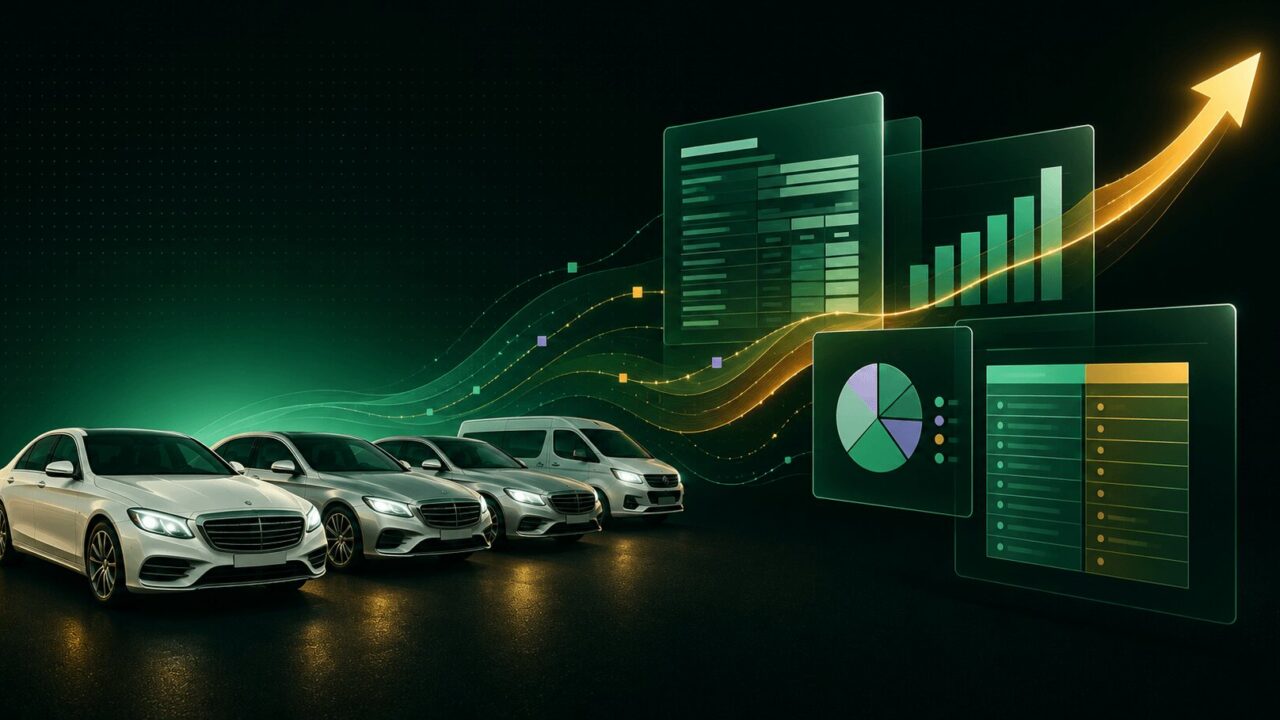
Fleet Management Software With Accounting: How to See Profit Per Driver and Per Vehicle
Ask a fleet owner how many trips they did last month and the answer arrives in seconds. Ask what they kept from those trips and the room goes quiet.
That silence is not carelessness. It is the predictable result of how fleet software is built. Almost every system on the market is an operations system: it manages jobs, drivers, vehicles, bookings and expenses. Very few are accounting systems. The two are not the same thing, and the distance between them is where most transport businesses lose visibility of their own money.
This guide covers what that gap actually is, how to calculate profit per driver and per vehicle correctly (including the cost nearly everyone forgets), and what to check before buying any fleet management software that claims to handle your accounts.
What this guide covers
- Why your fleet software shows trips but never profit
- How to calculate profit per vehicle and per driver
- The cost almost every fleet forgets
- Operational profit vs accounting profit
- A buyer’s checklist: 12 things to test before you pay
- Why “international” software often is not
- Frequently asked questions
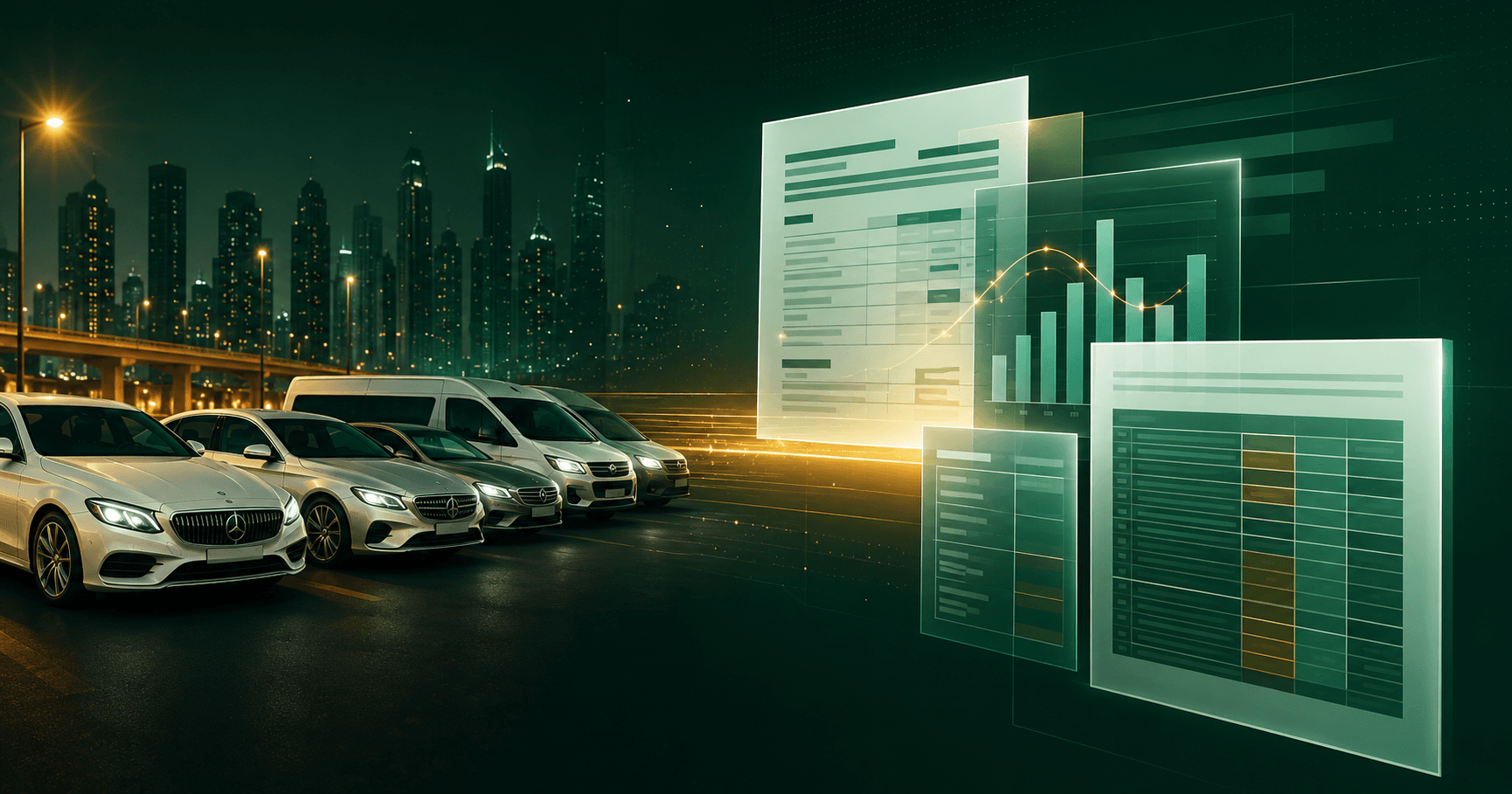 The gap between what a fleet records and what it can prove.
1. Why your fleet software shows trips but never profit
Operations software answers questions about activity. How many jobs ran today, which driver is free, which car is due for service, how much fuel went into vehicle 12. These are the right questions for a dispatcher and they are answered well by most systems.
Accounting answers questions about value. What did we earn, what did we owe, what do we own, what is left. Those questions require something operations software almost never keeps: a double-entry ledger.
Double-entry means every transaction is recorded twice — once as a debit, once as a credit — so the books always balance. It sounds like bureaucracy. It is actually the mechanism that makes three things possible:
- A trial balance, which proves nothing was recorded incorrectly
- A profit and loss statement, which shows what you earned and spent in a period
- A balance sheet, which shows what you own and owe at a point in time
Without a ledger, software can display revenue and it can display expenses, and it can subtract one from the other. What it cannot do is produce figures an auditor, a bank or a tax authority will accept. So the books get closed separately, later, by an accountant working from spreadsheet exports — and the version of reality in your software drifts away from the version in your accounts.
2. How to calculate profit per vehicle and per driver
You can do this by hand. It is worth doing at least once, because it shows you exactly which costs your current system is not capturing.
Profit per vehicle
Trip / fare income attributed to the vehicle
+ Rental or lease income from the vehicle
+ Any recharges billed to clients for it
= Total vehicle revenueDIRECT COSTS
Fuel or charging
+ Tolls (Salik, FASTag, ERP, or your local equivalent)
+ Parking and fines
+ Maintenance, servicing, tyres and batteries
+ Insurance for the period (annual premium ÷ 12)
+ Registration and permit fees for the period
+ Depreciation for the period
= Total direct costVEHICLE CONTRIBUTION = Total revenue − Total direct cost
Note the word contribution rather than profit. Office rent, salaries for non-driving staff, software and the accountant are real costs, but they cannot honestly be traced to one car. Spreading them across vehicles by an arbitrary rule produces a number that looks precise and means nothing. Report them separately as overheads, and subtract them from the total contribution of the whole fleet.
Profit per driver
Fares, platform earnings and tips generated by the driverDIRECT COSTS
Salary, commission or rental share
+ Fuel and tolls he consumed
+ Fines and damage charged to him
+ Visa, permit and medical costs for the period
+ End-of-service accrual for the period
= Total driver costDRIVER CONTRIBUTION = Revenue − Total driver cost
3. The cost almost every fleet forgets
Depreciation is the single most commonly omitted cost in transport businesses, and for a fleet it is frequently the second largest after fuel.
The reason it is forgotten is that no money leaves the bank. Nobody sends an invoice for it. But the car is worth less at the end of the month than it was at the start, and that loss is a real cost of having earned the money you earned.
The standard method is straight line:
A vehicle bought for 60,000, expected to be worth 6,000 after five years:
= 10,800 per year, for five years
Nine hundred a month, per car. On a twenty-five car fleet that is 22,500 a month of genuine cost that never appears on a bank statement. A fleet that ignores it will believe it is profitable for years, and then discover the truth on the day it has to replace the vehicles and finds there is no money set aside to do it.
There is a second half to this that fleets get wrong even more often: what happens when you sell the car. A disposal is four things at once — the money coming in, the asset leaving the books, the accumulated depreciation being removed, and whatever is left recognised as a gain or a loss. Get one of the four wrong and the balance sheet stops balancing.
 Straight-line depreciation over a five-year life, with book value falling each month.
4. Operational profit vs accounting profit
These two numbers are almost never the same, and knowing why protects you from unpleasant surprises.
| Operational profit | Accounting profit | |
|---|---|---|
| Comes from | Your operations system | Your ledger |
| Revenue counted when | The trip happened | The invoice was raised |
| Includes depreciation | Rarely | Always |
| Includes accruals | No | Yes |
| Includes unpaid invoices | Often counted as earned | Earned, but shown as a receivable |
| Auditable | No | Yes |
| Typically | Higher | Lower, and correct |
Operational profit is not useless — it is fast, and it is the right number for a daily decision about whether a route or a driver is working. But it is a management estimate, not a financial result. Any system that presents it as “your profit” without a ledger behind it is showing you an optimistic sketch.
See both numbers, on the same screen
Transportation TMS calculates profit per driver and per vehicle operationally and from the posted ledger. When the two agree, you can trust the figure. When they disagree, you know exactly which cost is missing.
See how it works →
62 modules · 22 countries · 20 currencies · free 14-day demo with your own data
5. A buyer’s checklist: 12 things to test before you pay
Every vendor will say they “have accounting”. Most mean they have an expense list and an export button. These twelve questions separate the two, and you can ask all of them in a single demo call.
Does it actually keep books?
- Show me a trial balance. If there is no trial balance, there is no double-entry, and everything below is moot.
- Show me a balance sheet, and prove it balances. Assets should equal liabilities plus equity. A system that cannot produce this cannot tell you what your business is worth.
- Does revenue post to the ledger automatically, or only costs? This is the question that catches most systems out. Many post expenses and stop, which produces a ledger describing a business that spends money and never earns any.
- Show me a cash flow statement, and tell me where the figure comes from. If it is calculated from the profit and loss it can drift. If it is built from the cash and bank accounts, it cannot.
Does it handle the awkward realities?
- How do I record depreciation? Ask to see a monthly posting, not a spreadsheet.
- How do I sell a vehicle? Watch whether the system handles all four entries or leaves you to journal it manually.
- How do I cancel an invoice I have already issued? The right answer is a credit note. If the answer is “delete it”, walk away — that destroys the audit trail and leaves declared tax unaccounted for.
- Show me receivables aging. Current, 1–30, 31–60, 61–90, 90+. If they cannot show who owes you and for how long, they cannot help you collect.
- Can I close a period? Once a month is filed, nobody should be able to post into it — including an administrator.
Does it fit where you actually operate?
- Change the country and show me the driver form again. Does it now ask for the correct national ID, the correct professional permit and the correct vehicle registration document — or does it still say “Emirates ID” in a market that has never issued one?
- Change the currency and open a PDF. Does the decimal precision change where it should? Kuwaiti Dinar and Bahraini Dinar use three decimal places; getting this wrong on an invoice is embarrassing in front of a client.
- Who can reach payroll? Ask them to demonstrate the restriction being enforced, then ask whether it is enforced in the browser or on the server. If permissions are only checked in the browser, anyone with a valid login can reach payroll by calling the API directly.
6. Why “international” software often is not
Fleet software is usually written for one market and then sold into others with the labels left alone. It is a small-looking problem with an expensive consequence.
Consider a driver record. In the UAE it needs an Emirates ID, an RTA card and a Mulkiya. In Saudi Arabia that same record needs an Iqama, a Public Transport Card and an Istimara. In India it is an Aadhaar, a PSV badge and an RC — and the Aadhaar has no expiry date at all, so a field demanding one can never be filled.
When a field cannot be filled, it stays empty. When it stays empty, the renewal reminder that depends on it never fires. And the first time anyone notices is at a checkpoint, when a licence turns out to have expired three weeks ago.
| Market | Identity document | Driving permit | Vehicle registration |
|---|---|---|---|
| UAE | Emirates ID | RTA Card | Mulkiya |
| Saudi Arabia | Iqama / National ID | Public Transport Card | Istimara |
| Qatar | Qatar ID (QID) | Limousine / Taxi Permit | Istimara |
| Pakistan | CNIC | Route Permit | Registration Book |
| India | Aadhaar (no expiry) | PSV Badge | RC |
| United Kingdom | National Insurance No. | Private Hire (PHV) Licence | V5C |
The same applies to tax. VAT at 5% in the UAE, 15% in Saudi Arabia, 20% in the UK, GST in India with a GSTIN instead of a TRN. And to tolls: Salik in Dubai is a brand name, not a word for road charges. Software that prints “Salik” on an expense form in Mumbai is telling your staff, every day, that it was built for somebody else.
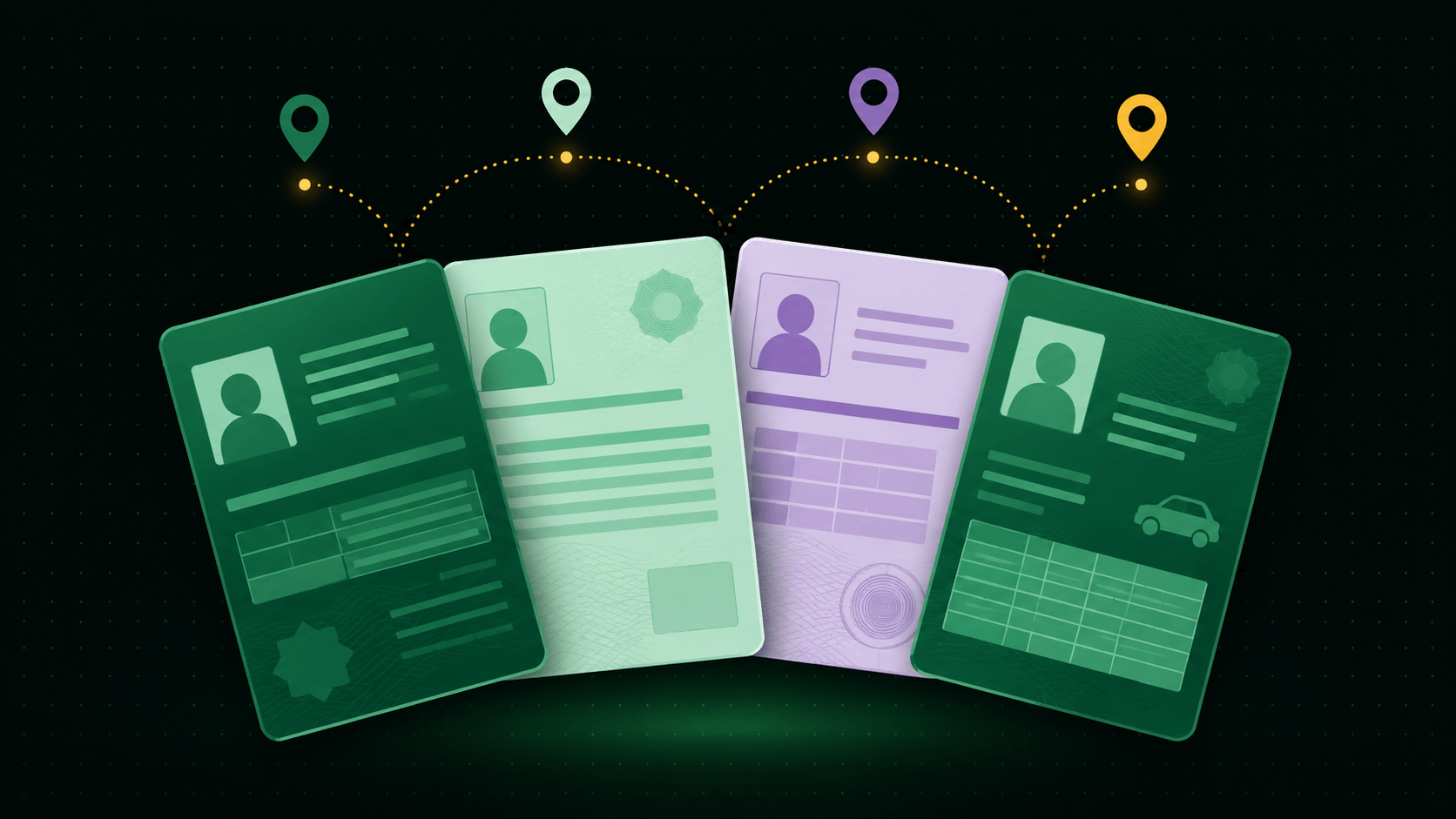 The same driver record, asked for correctly in four different markets
7. What this looks like when it works
The test of a fleet system is not how much it records. It is how little you have to re-type.
In a system where operations and accounting share one ledger, a driver finishing his shift fills in one summary on his phone: his platform earnings, his fuel, his tolls, his parking, with photographs of the receipts. From that single entry:
- The fuel becomes a line in Fuel Management, with the receipt attached
- The tolls and parking become expense records against the right vehicle
- The trips become revenue against the right driver
- All of it posts to the journal as balanced double entries
- And the trial balance, profit and loss, balance sheet and cash flow update
Nobody at the office typed anything. The month does not need closing because it was never open — and when the accountant asks for the books, they already exist.
That is the difference between software that records your business and software that runs it.
Frequently asked questions
How do you calculate profit per vehicle in a fleet?
Take every unit of currency that vehicle earned in the period, then subtract every cost that can be traced to it: fuel, tolls, parking, maintenance, insurance for the period, the driver’s pay attributable to it, and depreciation. Costs that cannot be traced to one vehicle — office rent, software, the accountant — are overheads and should be reported separately rather than spread arbitrarily. Depreciation is the line most fleets forget, and it is usually the second-largest cost after fuel.
Why does my fleet management software not show my profit?
Most fleet systems are built around operations: jobs, drivers, vehicles and trips. They record revenue and some costs, but they do not keep a double-entry ledger. Without one there is no trial balance, no profit and loss statement and no balance sheet — so the software can show you what you earned but cannot tell you what you kept. The books are still closed manually, months later, by an accountant working from exports.
What is the difference between operational profit and accounting profit?
Operational profit is revenue minus the costs recorded in the operations system. Accounting profit is what remains after every cost recognised under accounting rules, including depreciation, accruals, provisions and tax. Operational profit is usually higher — which is why a fleet can look profitable all year and still show a loss in the audited accounts.
Does fleet software really need double-entry accounting?
It needs it if you want the same numbers your accountant and your tax authority will use. Double-entry is what makes a trial balance balance, what allows a balance sheet to be produced, and what makes figures auditable. Without it you have an excellent record of your operations and a separate, later, unverified guess about your finances.
How much should fleet management software cost?
Pricing follows one of two models: per vehicle or per driver, which grows as your fleet grows, or per company with a user limit, which does not. Foreign platforms commonly charge USD 300–800 a month for a mid-sized fleet. Regional systems priced per company start considerably lower. The larger hidden cost is usually staff time spent re-typing driver sheets — for a 25-vehicle fleet that is often more than the software itself.
Can drivers use it without installing an app?
They should be able to. Requiring an app store install for drivers creates an onboarding problem on day one and a per-driver licence cost for ever. A browser-based driver portal opened by QR code works on any phone, needs no training, and should not be charged per driver.
The short version
- Operations software counts activity. Accounting software counts value. Most fleet systems only do the first.
- Profit per vehicle and per driver are contributions — overheads should be reported separately, not spread.
- Depreciation is usually the second-largest cost in a fleet and the one most often ignored.
- Ask any vendor for a trial balance and a balance sheet. The answer tells you everything.
- Software written for one country and relabelled for another leaves fields nobody can fill — and reminders that never fire.
Close your books without closing your month
Transportation TMS is a fleet, limousine, taxi and rent-a-car system with full double-entry accounting built in — trial balance, profit & loss, balance sheet, cash flow, aging, depreciation and cost centres, all reading one ledger. 62 modules, 22 countries, 20 currencies, and a free driver portal with unlimited drivers on every plan.
See all 62 modules →
Free 14-day demo with your own data · No card · WhatsApp +971 58 274 1165